Category Archives: Observations

Virtual bathroom wall: teen girls, Honesty Box and cyberbullying

If you have preteen or teenaged girls, you should know about websites (and Facebook apps) like Honesty Box or Fourspring.me and the potential pitfalls and risks they pose.

What are they all about? These sites are the web 2.0 equivalent of writing on the bathroom wall. They invite users to post mostly anonymous, public “constructive” criticism about each other. Honesty Box promises anonymity to users until they accumulate enough HB points to see what others have been saying about them. So users can tell each other what they really think about whether they look hot, if their boyfriend is cheating on them or if those new jeans make them look fat. Helpful stuff.

Fourspring.me invites users to post questions about anything and invite responses from other users. While some may use the site to get homework queries solves or address philosophical issues (“What came first: the chicken or the egg?”), most of the teen users take advantage of the site’s potential for stirring up muck and spreading rumours. It’s a dangerous recipe for hurt, paranoia and damaged self-esteem.

Honesty Box has provoked a lot of controversy as a consequence of the cyberbullying it enables. Users may find themselves targeted in malicious and extremely hurtful ways. An unsuccessful campaign was launched on ReallyWorried.com to get Facebook to remove the app. On the Internet, free speech generally prevails unless the PR tide turns ugly or money can no longer be made.

Producer Lynn Glazier did a fabulous three-part audio documentary on teens and the Internet for CBC Radio this past winter (It’s A Teen’s World: Wired for Sex, Lies and Power Trips, Part 1-3), in which she asks a group of teen girls why anyone in their right mind would want to open themselves to potentially hurtful comments online. While many of them acknowledged that upsetting things had been written about them online, they persisted using the sites because the occasional unsolicited positive comment (“You have really nice hair”) made them feel so good.

As a parent, there are several things you can do about sites like these. One is to bring them up in discussion (which is not at all the same thing as a lecture), and ask them if they have heard about these sites and what they think of them.

The second is to show them some of the excellent and highly watchable stuff produced about them (such as the CBC piece mentioned above, or this excellent video on Kelsie’s Teen Talk). Bear in mind that you shouldn’t be forcing them to watch it, but rather opening up a dialogue. Watch it with them, if they are OK with that.

The third thing you should do is show them how to opt out of the Honesty Box app on their Facebook account (even if they already are subscribers, they can unsubscribe).

The Internet is full of both opportunities and challenges for kids and teens, but it’s hard to see how sites and apps like these can be said to offer anything positive at all.

 

   Send article as PDF   

In praise of boredom

One of best things about summertime is the invitation to embrace a bit of laziness. Our hectic winter schedules get put aside. We can sleep in on hot summer mornings and stay up late on hot summer nights. There are no battles over homework, mealtimes tend to be later and more informal and there is generally less tension all around as we relax into a slower pace of life for a few precious weeks.

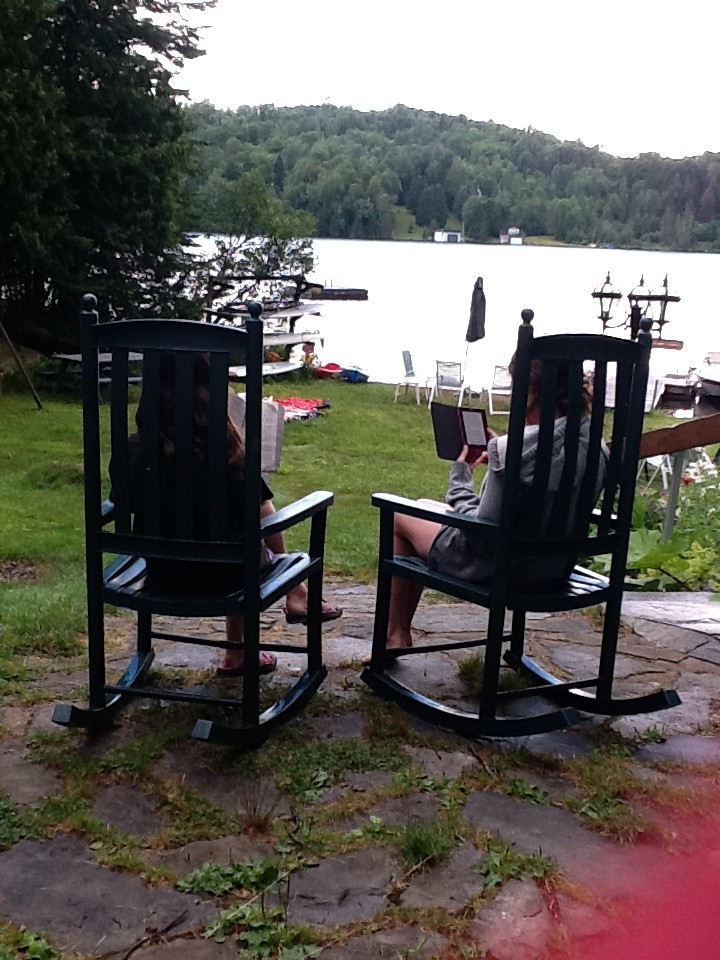
In between our travels and the occasional week at a summer camp, we settle in up at our favourite place in the whole world, a family cottage by a lake in the Laurentian mountains north of Montreal. It’s very comfy, but certainly more rustic than our city life. The 3 girls share one room and everyone has to pitch in to keep the smaller space uncluttered and habitable. My parents are often there as well, and 3 generations under one small-ish roof means lots of wonderful memories and also a need for consideration and compromise.

While we do have both cable television and wifi at the cottage, we strongly encourage everyone spend most of their time outdoors. The girls initially bristle when I put limitations on screen time, since they don’t have homework or other demands, but we all gradually settle in to a slower pace of life. Shelves of toys accumulated over the years generally go untouched. We do a lot of reading. We swim or hang out with friends and family. We spend a lot of time making and eating food.

An every once in a while, when someone whines about how bored they are, I’m secretly very pleased.

I’m a big fan of bored kids. Boredom is the catalyst for creativity. Boredom is the reason they scour the recycling pile for old newspapers, which they rip into shred ands dip in a gloopy flour and water mixture to make papier mache. Boredom is the engine behind the elaborate homemade board games they invent, and then forget the next week. Boredom is the only way our dog gets groomed or taught new tricks. Boredom leads to all sorts of experiments in the kitchen, many involving chocolate, some of which were even edible.  We’ve had treasure hunts invented, imaginary maps created, treehouses built.

Famous writers, from Nelson Mandela, to Martin Luther King, Jr., O. Henry and Antonio Gramsci, used the enforced idleness of their imprisonment to create some of the most important and enduring ideas and stories of our time.

There is a big difference between kids who are constructively bored and negatively numbed, however. We need to remember that boredom itself is a very modern concept. Prior to the 19th century, only the wealthiest people had any idle time on their hands, since simply eking out an existence required constant effort. A combination of labour-saving devices, the modern electronic entertainment industry and a coddled approach to child-rearing has left ou kids — and ourselves — expecting constant stimulation. I see it with my university students, who expect their professors to keep their attention with elaborate multimedia presentations and interactive activities.

Kids who are bored might initially spend more time bickering, but then realize they need to depend on each other to find something to do. My daughters have spent long afternoons by the lake engaged in made-up activities together, when they might otherwise not be able to endure even the 10-minute ride home from school in each others’ company.

Kids who are bored need to learn to figure out how to occupy themselves. They need to be creative, a quality that is notoriously difficult to teach. In fact, some suggest that too much conventional teaching actually erodes the natural creativity of children.  The satirist P.J O’Rourke famously declared colleges to be places where “pebbles are polished and diamonds are dulled.”

The unstructured time we give our kids helps them explore their inner and outer worlds. It requires effort on their part to figure out what they want to do. It is ungraded, un-evaluated and unremarked upon by anyone other than themselves. It offers freedom, but can be intimidating to kids who are used to be stimulated, to getting toys that instruct them to follow rules to predetermined ends. It takes a bit of practice to get good at being bored.

The tricky part is that sometimes we parents need to be involved. We aren’t so good at being bored either. Sometimes our kids who claim to be bored need a bit of parental bonding. Or they need supplies or ingredients or a supervisory eye while they play capture the flag with canoes.

It’s a good lesson for all of us. And lazy summer afternoons are the best time to do this kind of learning.

   Send article as PDF   

Graduation time

Creative Commons license CarbonNYCTwo nights ago my twin daughters, along with 46 classmates, graduated from their elementary school. The occasion involved a morning service, with breakfast for families, along with an evening program of graduate speeches (in which each kid had their own 45-second speech presented in three languages), handing out of diplomas, dinner and dancing.

A full day of celebration, an emotional, full-pack-of-Kleenex affair for a sentimental person like me. Our babies had  grown so much and so far, and damned if we weren’t going to mark it properly.

Now I’ve had six graduations of my own over the years, and I can tell you that none were as involved and exhaustively detailed as this ceremony sending 11 and 12-year-olds off to high school.

That being said, there is something particularly momentous about the move from primary to secondary school, especially here in Canada where we don’t have middle schools. In some ways, it is probably a bigger deal than going from high school to college. They are leaving the institution they entered as baby-faced four-year-olds, moving on in awkward new bodies to schools where they will now be the youngest. They may have 12-year-old minds and accumulated good judgment, but some will already look 16. Or even 18.

The range of issues they will contend with will be bigger, with more serious consequences for poor judgment. They will be expected to assume responsibility for their own actions, solve their own problems, make their own important decisions. They will be tempted by new influences, by cigarettes, alcohol, drugs and sexual activities. They will reach the age of medical consent (14 in most cases in Quebec, 16 in most other provinces), and the age of sexual consent (16 across Canada, between 16 and 18 across the U.S.). They will be allowed to drive cars, vote and join the military.

It’s one of the trite sayings of parenthood that little kids have little problems and big kids have big problems. When you have a six-year-old who isn’t yet reading, or a seven-year-old who has no friends, this seems to ignore the gut-wrenching worry parents may experience. But it makes sense, because it takes into account the consequences of these problems: the six-year-old (most of the time) will be seen to by parents, teachers and resource personnel who can make his problem go away, and the seven-year-old will most likely (sometimes with supervision) find her counterpart somewhere in the schoolyard. But the fifteen-year-old who decides to try ecstasy or heroin “just once” may end up in a downward spiral of legal, medical, social and academic problems that can haunt him for a lifetime.

The last unit my daughters’ amazing English teacher, Stacey, taught this group of grade 6’ers before the end of the year was on drug awareness. They read the controversial, classic novel Go Ask Alice, did multimedia presentations on common drugs, had powerful visits from some rehabilitated teenage drug addicts doing community service and, separately, from two wonderful police officers. In her graduation speech to the class and their families last night,  she reminded them, as they headed off on the next exciting chapter of their young lives, to ask with each new opportunity, each difficult decision, “Does this fit in with who I am?”

I thought this was brilliant. This simple sentence crystallizes exactly what we want our children to learn. It asks them to listen to that emerging inner voice, the collective wisdom of one’s experiences, advice from parents and teachers. The voice we all have, and sometimes — often to our own detriment — ignore (that second slice of pizza, that third martini, that guy at the party…). It encourages our kids to think about who they want to be, what core values they want to espouse. It evokes the family and communities that help flesh out our identities. It means respecting yourself.

I know plenty of adults who might want to keep this important question handy as they go about their daily lives.

So for all the graduates out there  (and parents of graduates), whether moving from  middle school to high school, university to grad school or even considering making a leap from an unsatisfying job, consider keeping that question filed away, but close enough at hand for quick reference:”Does this fit in with who I am?”

   Send article as PDF