Tag Archives: parenting

Parents, kids and technology survey – update

This isn’t just your usual boring, annoying reminder to participate in my quick parenting survey about kids and technology. That’s because the initial response has been so positive, and I’d like to share a few of the emerging facts BEFORE I urge you all to: 1) spend two minutes to complete it yourself (if you haven’t already) and 2) to please share/ repost it for your friends and followers.

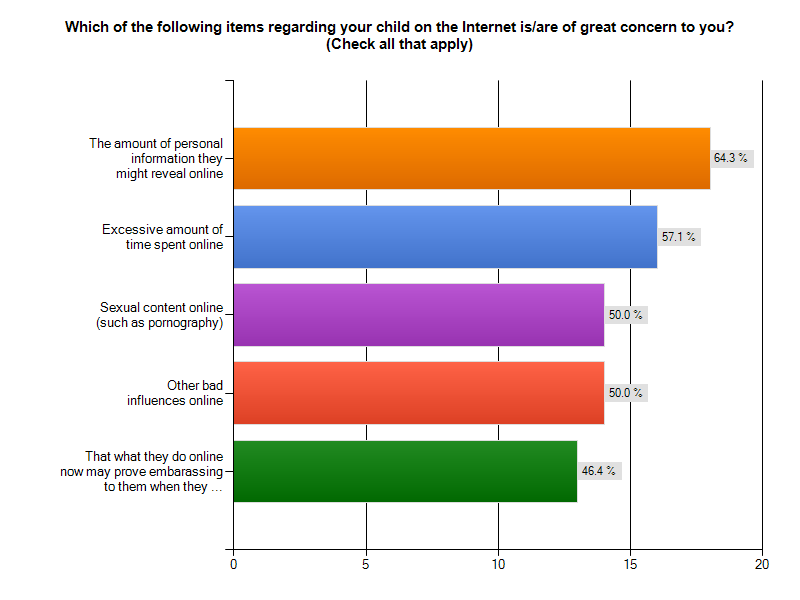
One of the questions I ask parents was what their top concerns were about having their kids online. Now it’s important to bear in mind that all my respondents, since they found me through my blog, LinkedIn, Facebook, Twitter or some other online source, are already at least somewhat comfortable online, and this may colour their responses somewhat. Nevertheless, their top 5 concerns jive pretty closely with what I’ve been hearing from parents in workshops over the years.
Chart

Personal information is really a huge concern, as it should be. Not only do parents worry about the privacy issues, but they are also concerned their kids may jeopardize their future job and social prospects with inappropriate posts now while they are young. Time is a huge issues, and helping our kids control the impulse to be online constantly is a difficult battle to win when most adults struggle with the same issue. Finally, dealing with sexual and violent content on the Internet remains a justifiable concern, as research indicates in desensitizes our kids to these things at younger and younger ages. There are other concerns listed here as well, and some parents were kind enough to share their own fears with me as well.

These results are fascinating to me, and I plan to spend a lot more time discussing them individually, but I need your help. The amount of data I’ve collected is a great start, but I’m still limited by what I can say until I get the numbers of responses up there. Please help me out by sending the link (https://www.surveymonkey.com/s/RWRparentsurvey) to your friends and colleagues, sharing it on your walls or Twitter accounts, or even putting it at the bottom of your own blog posts.

In return, I promise to write about the results and offer some practical suggestions to parents and teachers based on current research, best practices and whole load of common sense. Because as a mom of three pre-teens/ teens myself, I know how confusing it can be to stare at a lot of scary numbers.  My goal is to translate those charts into practical steps that will make sense in your home, with your kids.


   Send article as PDF   

Digression: A very sad story about the tooth fairy

Before I begin this post, I feel I should say in my defense that I had been up working until midnight the evening before.

Tooth fairyWhen I went to bed, the small bloody tooth in an envelope under my daughter’s pillow had drifted to the very back of my overtaxed brain. And since my husband and I had been tag-teaming family duties the past few days, he hadn’t even been told about the lost tooth. And quite frankly, when your third kid loses their 11th tooth (or whatever), it’s not as exciting as it used to be.

So.

When morning came far too early the next day, and I dragged myself on crutches (a story for another post) over to her room to wake her, I was momentarily stumped by the crumpled face and sobbing when she reached under her pillow to retrieve the envelope that should no longer have been there.

Now my littlest girl is nearly nine years old, and she’s very precocious. You can call it social intelligence or manipulation or whatever, but she has a pretty sophisticated take on how to work people. And she thrives on drama. So while her big blue eyes were welling up with tears, I couldn’t escape the feeling that she had also pinned me down, as if to say “I know that you know that I know. But we’re not going to talk about it. I’m still your baby and you forgot to play your tooth fairy game and this is going to cost you BIG TIME in therapy bills one day.”

This kid was born knowing.

Not that it really matters. The truth is, our tooth fairy had crashed and burned. Major parenting fail.

Since my recovering knee meant I was in no shape myself to run downstairs and grab some money from my wallet, I hugged her hard, sent her off to the bathroom to wash up and dragged my husband out of the shower to find a $5 bill. Spare me your comments if you think we overpaid (or underpaid), or your children are delighted by a shiny apple or a spanking new toothbrush as a tooth fairy gift. Good for you. This was guilt money, and at 6:30 that morning we were willing to pay a premium for the lost premolar.

He shoved the bill under the pile of pillows on her bed. When she came back into the room, I gently suggested she check again for her prize. Perhaps it had gotten tangled up in the groupings of stuffed animals and decorative pillows?

Why yes. Yes, it had. Whew.

The tears stopped. She smiled prettily at me from under her lashes. And I knew that she knew that I knew. And she still has 13 baby teeth left.

Oh yes, this is going to cost me.

—————————–

Have you taken our quick parenting survey yet? Take two minutes out of your day to complete this anonymous, confidential survey about kids and the Internet: https://www.surveymonkey.com/s/RWRparentsurvey

   Send article as PDF   

Survey: Parents, share your concerns about kids and technology

Power ButtonThe very best part of the work I do at Risk Within Reason is the direct contact with parents, teachers, students and readers. I learn something new every time I do a presentation , and the questions I get from audiences and my blog readers help keep me focused on the current issues for schools and families. Which I then pass on to my readers and workshop participants.

Like the explosive growth of Twitter use among teens, partly (they say) because their parents are watching them too closely on Facebook. Or the ways they use video chat to communicate things with friends without leaving a trail. Or the truly creative use  of blogging, animation and gaming sites to produce things (from  photos to animation to game design and coding) that teens couldn’t have imagined doing even 10 years ago.

It isn’t all bad stuff. It isn’t all scary. Our teens are bright and earnest and curious. But we do need to watch them very carefully. And I like to think that by helping keep my readers informed about these complex and ever-changing issues, I make it easier for them to know what to watch.

When I do workshops on digital safety in schools, I always send out quick surveys beforehand — one for the students and one for the parents. That way I can integrate data from that school into my talk; they like to know what their students and parents believe.

The results are fascinating. They’ve shown me an interesting disconnect between the fears and concerns of both groups, as well as not too surprising differences between the household Internet and cellphone rules as understood by the kids and their parents. It’s a topic I plan to write about soon.

But before I do, I need your help. I’m trying to collect more information about parents’ concerns. What are you worried about when it comes to your kids and technology? How do you deal with those worries? What do you wish your kids knew?

If you have children under the age of 18, please take  5 minutes from your busy schedule to complete this simple 10-question survey. If you have more than one child, pick one between 10 and 16 when you consider your responses. It’s anonymous and confidential. And I promise to write all about it here on Rise Within Reason.

Click here to take survey and then share it with your friends by forwarding the link to this post: http://wp.me/p1S4ya-fX.

Thank you!

Alissa

   Send article as PDF